8 Best Car Exercise Equipment for Commuters and Long-Distance Drivers in 2026
Published: September 14, 2022 | Last updated: August 30, 2026 | 12 min read
The average American spends 54 minutes per day commuting by car (U.S. Census Bureau, 2024). The right car exercise equipment turns that dead time into active recovery, circulation improvement, and light strength work – no gym required.
TL;DR
- Best overall car exercise equipment: Cubii Move Compact Seated Elliptical – whisper-quiet, compact, works under any seat or desk
- Best for back pain relief: Comfier Shiatsu Seat Cushion Massager with heat and lumbar support
- Best budget pick: Wakeman Fitness Under-Desk Pedal Exerciser at around $32
- Best for upper and lower body together: MagneTrainer-ER Mini Exercise Bike with dual-use arm and leg pedaling
- Key buying rule: if it fits under a standard desk, it fits in a passenger-side footwell or an RV seat
Why Car Exercise Equipment Is Worth Taking Seriously
Car-seated exercise equipment gives commuters a way to move during time that would otherwise be fully sedentary. This matters more than most people realize.
A 2024 study in JAMA Network Open found that people who sit for extended periods at work face a 34% higher risk of death from cardiovascular disease compared to those who move more throughout the day (UPMC HealthBeat, 2024). Separate research published in the Journal of the American College of Cardiology found that more than 10.5 hours of sedentary behavior per day is significantly linked to future heart failure – even among people who exercise regularly (American College of Cardiology, 2024).
The average American drives 69% of the time to work alone (U.S. Census Bureau, 2024). For someone with a 45-minute commute each way, that is 7.5 hours per week sitting in a car seat before factoring in desk time.
Car exercise equipment does not replace a gym session. But a mini pedal exerciser or resistance band routine in a parked car or passenger seat can improve circulation, reduce lower-leg stiffness, and support muscle activation during what is otherwise dead time.
What to Look for in Car Exercise Equipment
Before diving into the list, here are the criteria used to evaluate each option:
| Criterion | Why It Matters |
|---|---|
| Footwell clearance | Standard car footwells are 10-14 inches deep – the equipment must fit without obstructing pedals |
| Noise level | Squeaky or mechanical equipment is distracting and annoying on a commute |
| Weight capacity | Most compact exercisers support 250-300 lbs; check this before buying |
| Resistance range | At least 6-8 levels lets you scale from light recovery to actual cardio |
| Portability | Under 20 lbs means you can move it between car, home, and office |
| Power source | Battery or passive magnetic is better than corded for car use |
| Dual-use capability | Equipment that works for both arms and legs gives more value per dollar |
| Safety | Should not interfere with driver controls; driver-side use is only for parked situations |
In-Depth Reviews
These eight options cover different use cases – from full-leg cycling to back massage and isometric strength exercises. Each was selected based on verified user feedback, expert review sources, and fit with car or travel seating dimensions.
1. Cubii Move Compact Seated Elliptical – Best Overall Car Exercise Equipment
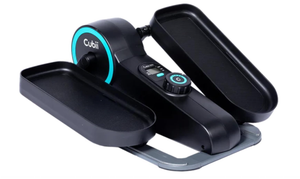
The Cubii Move is the top pick for anyone who wants a real workout from a seated position. It delivers an elliptical motion that activates six lower-body muscle groups – calves, hamstrings, quads, hip flexors, glutes, and shins – without the jarring up-and-down motion of a standard bike pedal.
Key features:
- 6 adjustable resistance levels
- Built-in LCD monitor tracks strides, calories, distance, and speed
- Whisper-quiet flywheel – no mechanical noise
- Weighs under 20 lbs
- Connects to Cubii Studio+ app with 300+ on-demand classes
Pricing: Around $159 (Walmart, 2026)
The Cubii Move fits in front of most passenger-side footwells and under standard RV seating. One verified user review on Cubii’s site (December 2025) confirmed they use the device while traveling in an RV, pedaling while seated as a passenger. That real-world use case is exactly what makes it the strongest option in this category.
The elliptical stride keeps knee angle shallow, which matters for people who already have tight hip flexors from prolonged driving. Standard pedal bikes force a deeper knee bend that can be uncomfortable in a reclined car seat. The Cubii’s motion is better suited to that reclined angle.
The six resistance levels are wide enough to start with recovery-level movement and progress to moderate cardio. At level 6 for 45 minutes, users consistently report around 90-100 calories burned, per Healthline’s hands-on review (2022).
Pros:
- Quiet enough to use without disturbing conversation or audio
- LCD monitor works without the app
- Compact enough to store in a car trunk between uses
- 300 lb weight capacity
Cons:
- Short range of motion compared to a full elliptical
- Six resistance levels may feel limited for fit users
- Higher price point than basic pedal exercisers
Best for: Passenger-side car use, RV travel, office desk workers who also commute
Not ideal for: Drivers who want to use it while moving (never use while operating a vehicle)
2. MagneTrainer-ER Mini Exercise Bike – Best for Arm and Leg Training
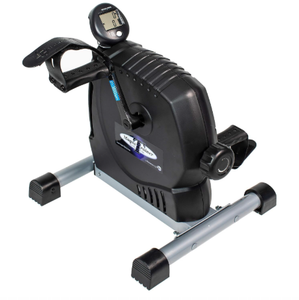
The MagneTrainer-ER is one of the few compact pedal exercisers that works as well for upper-body training as it does for legs. It weighs 23 lbs, uses magnetic resistance, and runs virtually silent.
Key features:
- Magnetic resistance with bidirectional pedaling
- Works for both arm cranking and leg pedaling
- Hospital-grade build – used in physical therapy and rehabilitation settings
- Non-labeled resistance dial (users recommend marking settings with stickers)
- Velcro floor tether included for slick or wheeled surfaces
Pricing: Around $199-$230
This is the option physical therapists reach for after knee, hip, or ankle injuries, per tested reviews from yourexercisebike.com (2025). The frame is heavy enough to stay put on carpet without sliding, and the bidirectional motion supports both push and pull muscle groups.
For car use, the MagneTrainer-ER fits best in larger vehicles – SUVs, minivans, and trucks – where the footwell is wider. In sedans, it fits on the rear passenger floor while a passenger uses it from the back seat. For upper-body sessions, it sits on the seat itself and the user cranks with their arms.
The machine’s 23-lb weight means it does not slide during pedaling without the tether, even on a leather car seat surface.
Pros:
- Dual-use design covers both arms and legs
- Hospital-grade smooth motion
- Quiet enough for library or car use
- Bidirectional pedaling works different muscle groups
Cons:
- Heavier than most compact options at 23 lbs
- Resistance dial is not labeled out of the box
- Higher price than standard pedal bikes
Best for: Rehabilitation users, anyone recovering from a lower-body injury, people who want upper-body activation during a long drive (passenger side only)
Not ideal for: Budget buyers, small sedans with limited rear footwell space
3. Comfier Shiatsu Seat Cushion Massager – Best for Back Pain and Circulation
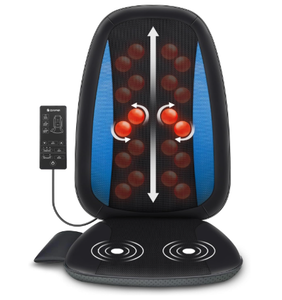
The Comfier seat cushion massager is not a traditional exerciser – it targets muscle tension, circulation, and lower-back support passively. For drivers who deal with chronic lower-back pain from long commutes, this is the most practical tool on this list.
Key features:
- Shiatsu kneading nodes target neck, shoulders, upper back, and lower back
- Integrated heat for muscle relaxation
- Built-in lumbar support
- Remote control for adjustments while seated
- 20-minute auto shut-off (standard safety requirement for in-car electronics)
- Car adapter included
Pricing: Around $60-$80
The Comfier works through vibration and kneading nodes rather than exercise motion. Research from Cleveland Clinic shows that reducing prolonged sitting tension – even through passive means like massage – can support circulation and reduce the muscle stiffness that worsens fatigue on long drives (Cleveland Clinic, 2025).
The auto shut-off is a key feature for drivers who forget to turn devices off. The 20-minute timer resets with a button press, making it safe and repeatable without driver distraction.
The remote control is the practical detail that makes this work in a car. Adjusting massage mode or heat level without reaching behind your back is essential when you are driving.
Pros:
- Works passively – no physical effort required from the driver
- Car adapter and home plug both included
- Heat and kneading combination addresses deep muscle tightness
- Fits most car seat profiles
Cons:
- Thinner padding than some users expect – the nodes can feel firm against bony areas
- Massage straps can shift on slick leather seats
- Not a substitute for active exercise
Best for: Long-distance drivers, delivery drivers, anyone with chronic lower-back tension from sitting
Not ideal for: People looking for calorie-burning exercise rather than recovery and tension relief
4. LifePro Under Desk Exercise Bike – Best for Seniors and Beginners
The LifePro Under Desk Exercise Bike is designed specifically for low-impact use by seniors, beginners, and people in rehabilitation. It has a sturdy transport handle, adjustable resistance, and a low profile that fits comfortably under desk height.
Key features:
- Compact magnetic resistance design
- Works for both arms and legs
- Sturdy transport handle for easy repositioning
- Compatible with aftermarket 9/16 pedals for wider feet
- LCD display for tracking
Pricing: Around $89-$119
Per hands-on testing at yourexercisebike.com (2025), the LifePro is the strongest option for seniors and rehab users who need something that is easy to move and simple to operate. The transport handle is genuinely useful when moving the device from car trunk to a chair or desk.
The pedals are standard size, but reviewers with wide feet recommend swapping to aftermarket 9/16 pedals for a more secure fit. This is a $10-$15 upgrade that significantly improves comfort for larger shoe sizes.
For car use, the LifePro fits in the rear passenger footwell of most mid-size sedans and all SUVs. A passenger uses it during travel to keep legs active without needing to exit the vehicle at rest stops.
Pros:
- Comfortable for extended sessions
- Easy to move between locations
- Good for both arms and legs
- Well-suited to seniors and post-injury recovery
Cons:
- Standard pedals may feel small for users with larger feet
- Not designed for high-intensity workouts
- Motor on motorized version is heavier and better suited to home use
Best for: Seniors, beginners, post-surgical rehabilitation, anyone who wants gentle daily leg movement
Not ideal for: Fit users looking for a challenging workout, small rear footwells in compact cars
5. Wakeman Fitness Under-Desk Pedal Exerciser – Best Budget Pick
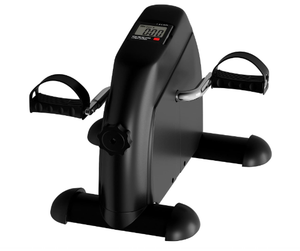
The Wakeman Fitness pedal exerciser is the lowest-cost option that still delivers a functional workout. It has adjustable resistance, a calorie tracker display, and foot straps to keep feet secure during pedaling.
Key features:
- Adjustable resistance dial
- LCD display tracks calories, distance, and time
- Secure foot straps
- Compact and lightweight
- Non-slip base
Pricing: Around $32 (Walmart, 2026)
At $32, this is the entry point for anyone who wants to try car seat pedaling before committing to a higher-end unit. The resistance is friction-based rather than magnetic, which means it is not as smooth as the Cubii or MagneTrainer – but it works.
The foot straps are important for car use because the device can shift on fabric or leather seat surfaces. The straps keep feet in contact with the pedals when the vehicle hits bumps or uneven roads.
For rear-seat passengers on road trips, the Wakeman is easy to pass around, requires no setup, and stores flat under a seat.
Pros:
- Very low cost
- No assembly required
- Foot straps keep pedaling stable
- Small enough to store in any car
Cons:
- Friction resistance is less smooth than magnetic options
- Louder than magnetic models
- Display is basic compared to app-connected units
Best for: Beginners, budget buyers, rear-seat passengers on road trips
Not ideal for: Serious fitness users, anyone who wants quiet operation
6. Resistance Bands – Best for Isometric and Strength Exercises in a Parked Car
A set of loop resistance bands is the most versatile car exercise tool. It weighs nothing, costs under $20, and covers leg press, chest squeeze, shoulder rotation, bicep curl, and hip abduction from a seated car position.
Key features:
- 3-5 resistance levels in one set
- Latex or latex-free options available
- Fits in a glove compartment or center console
- Works for both upper and lower body
Pricing: $12-$30 for a quality set (Amazon, 2026)
The key exercises that work from a car seat with resistance bands: loop a band around both thighs and push outward for hip abductors; loop a band around the steering wheel at low resistance and pull back for rows; use a band anchored under the seat for seated leg curls.
All of these are parked-car exercises only. Per University of Minnesota Extension guidance, any exercise involving hands off the wheel or extended holds should only be performed when the car is stationary (UMN Extension).
For travelers who want to use rest stops productively, resistance bands allow a full upper-body circuit on a picnic bench or tailgate without needing any additional equipment.
Pros:
- Virtually weightless and packable
- Covers the widest range of exercises of any option on this list
- Works for both strength and stretching
- No noise, no power required
Cons:
- Requires knowledge of exercises – not a plug-and-play solution
- Can slip or roll on smooth seat surfaces without anchoring
- Not suitable for use while driving
Best for: Active commuters who stop at rest areas, fitness-oriented travelers, anyone who already knows basic resistance band exercises
Not ideal for: Complete beginners who need guided movement, anyone looking for passive relief
7. Lumbar Support Cushion with Ergonomic Back Roll – Best for Posture Correction
A quality lumbar support cushion does not add exercise – it prevents the postural damage that long-distance driving causes. Poor driving posture is one of the fastest ways to build chronic lower-back pain, which eventually limits how much exercise you can do at all.
Key features:
- Ergonomic curve follows natural lumbar spine shape
- Memory foam or spring steel inner frame options
- Breathable covers for temperature regulation
- Strap attachment for car seat
Pricing: $15-$45
Per guidance from car ergonomics experts at Inshur (2024), the correct seating position for reducing shoulder, neck, and back strain requires: seat height so hips and knees align, steering wheel lowered and pulled closer, and lumbar support filling the gap between the lower back and the seat back.
Most car seats provide minimal lumbar support in their standard configuration. An add-on cushion fills this gap. For commuters who drive more than 30 minutes each way, a lumbar cushion is arguably the highest-return item on this list per dollar spent.
Pros:
- Works passively during every drive
- Prevents injury rather than treating it
- Low cost and zero effort
- Compatible with any car seat
Cons:
- Does not burn calories or strengthen muscles
- Fit varies by seat shape – mesh bucket seats may not hold the cushion well
- Needs to be washed regularly to avoid odor buildup
Best for: Anyone who drives more than an hour per day and experiences lower-back stiffness after driving
Not ideal for: People looking for active exercise rather than posture support
8. Grip Strengthener Set – Best for Hand and Forearm Strength During Any Drive
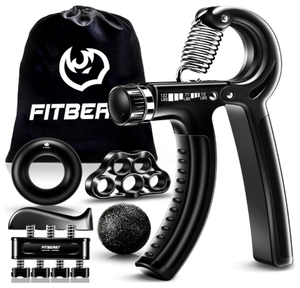
A grip strengthener is the one exercise tool a driver can safely use while moving. It requires no visual attention, no postural change, and no equipment repositioning. Squeeze sets target forearm flexors, extensors, and hand muscles.
Key features:
- 3 resistance levels (light, medium, heavy) in most quality sets
- Silicone or rubber body fits in one hand
- Squeeze-and-release motion works forearm muscles
- Small enough to store in a cup holder
Pricing: $10-$25 for a set of three
Cubii markets its own Squishii Grip Strengtheners as a companion to their seated elliptical, offering three ergonomically designed levels of resistance (Cubii, 2026). Independent sets from other brands offer the same function at similar or lower prices.
The exercise is simple: grip and hold for 5-10 seconds, release, repeat 10-15 times per set. Alternating between hands during a commute can complete 2-3 working sets without any change in driving behavior.
For drivers who spend 30+ minutes per day behind the wheel, consistent grip work over weeks will noticeably improve hand endurance and forearm definition.
Pros:
- Only exercise tool on this list that is safe for active driver use
- No setup, no power, no noise
- Very low cost
- Measurable strength progression over time
Cons:
- Only targets one small muscle group
- No cardiovascular benefit
- Easy to overdo if you compress too aggressively – start with a light resistance level
Best for: Active drivers, anyone who wants to make full use of every commute minute, office workers whose hand strength has declined from keyboard use
Not ideal for: People with arthritis or hand injuries – check with a doctor before starting any grip strengthening program
Comparison Table: Car Exercise Equipment at a Glance
| Product | Best For | Price (2026) | Active or Passive | Safe While Driving |
|---|---|---|---|---|
| Cubii Move Seated Elliptical | Best overall | ~$159 | Active | No – passenger use only |
| MagneTrainer-ER Mini Bike | Arm + leg training | ~$199 | Active | No – passenger use only |
| Comfier Shiatsu Seat Massager | Back pain and circulation | ~$70 | Passive | Yes – driver safe |
| LifePro Under Desk Bike | Seniors and beginners | ~$99 | Active | No – passenger use only |
| Wakeman Pedal Exerciser | Budget pick | ~$32 | Active | No – passenger use only |
| Resistance Bands | Full-body versatility | ~$20 | Active | No – parked car only |
| Lumbar Support Cushion | Posture correction | ~$25 | Passive | Yes – driver safe |
| Grip Strengthener | Hand and forearm strength | ~$15 | Active | Yes – driver safe |
Common Mistakes to Avoid with Car Exercise Equipment
- Buying an under-desk pedal bike without measuring your footwell first: most units are 15-18 inches wide – measure the passenger footwell before ordering, especially in compact cars.
- Using active exercise equipment while driving: only grip strengtheners and passive back massagers with auto shut-off are appropriate for driver use while moving. Any equipment requiring foot operation is for parked or passenger use only.
- Choosing friction-based pedal exercisers for quiet environments: friction resistance creates noise that magnetic resistance does not. If you share a car with others or use the equipment near sleeping passengers, go magnetic.
- Ignoring weight capacity: budget pedal exercisers often cap at 220-250 lbs. Check this specification if you are near or above that range.
Frequently Asked Questions About Car Exercise Equipment
What is car exercise equipment?
Car exercise equipment is any compact fitness tool designed for use inside or alongside a vehicle. It includes seated pedal exercisers, under-seat ellipticals, resistance bands, grip strengtheners, and back massagers sized to fit a car interior. The category specifically serves commuters, long-distance drivers, and passengers who want to stay active during travel time.
Can you exercise in a car while driving?
Only passive tools like lumbar support cushions, shiatsu back massagers, and grip strengtheners are safe for drivers who are actively operating a vehicle. All pedal exercisers, resistance bands, and leg-movement devices are for parked cars or passenger use only. Never use foot-operated exercise equipment on the driver side while the vehicle is in motion.
How much space does a compact pedal exerciser need?
Most compact pedal exercisers – including the Cubii Move and MagneTrainer-ER – are between 20 and 24 inches wide and 14-16 inches tall when in operation. A standard passenger-side footwell in a mid-size sedan or SUV provides enough clearance. Compact city cars and sports cars with smaller footwells may not fit most models without testing first.
Do under-seat ellipticals and pedal bikes actually burn calories?
Yes, though the number depends heavily on resistance level and how long you use the device. Per Healthline’s trainer-reviewed test of the Cubii (2022), 45 minutes of pedaling at a moderate resistance burned approximately 98 calories. That is comparable to a slow walk – meaningful for daily activity levels but not a substitute for structured cardio training.
What is the difference between a pedal exerciser and a mini elliptical like the Cubii?
A standard pedal bike creates a circular pedaling motion similar to a bicycle, which requires a wider range of knee flexion. A mini elliptical – like the Cubii line – creates an oval, gliding motion that keeps the knee angle shallower. The elliptical motion is more comfortable for reclined seating positions (like a car seat or desk chair) and is generally gentler on knees and hips. Pedal bikes are typically lower cost; ellipticals are smoother and quieter.
Who benefits most from car exercise equipment?
The people who gain the most from car exercise equipment are those who spend 30 minutes or more per day in a vehicle, work desk jobs, and have limited time for standalone exercise sessions. This includes: long-distance commuters, rideshare and delivery drivers, road travelers, and seniors or post-injury patients who need low-impact movement to maintain circulation and joint mobility.
Final Verdict
The Cubii Move is the best overall choice for anyone who wants real seated cardio from a compact, quiet device that works in a car, at a desk, or in an RV. If budget is the main concern, the Wakeman Fitness Pedal Exerciser at $32 does the job for beginners without complexity. For drivers who cannot use active equipment while moving, the Comfier Shiatsu Massager is the most practical pick – it works passively in the driver seat, requires zero physical effort, and directly addresses the back tension that long commutes cause.