Best 90s Exercise Equipment: A Comparison Guide for Nostalgia Buyers and Home Gym Builders
[Published: September 3, 2022 | Last updated: June 28, 2026] | 14 min readThese are the most iconic 90s exercise machines – ranked by real workout value, cultural staying power, and what each one actually does for your body.
TL;DR
- The Bowflex Home Gym is the best overall 90s machine: it uses polymer resistance rods instead of free weights and still delivers a solid full-body strength workout in 2026.
- The ThighMaster sold over 10 million units after Suzanne Somers launched it in 1990, making it the most commercially successful piece of 90s home fitness equipment by far.
- The NordicTrack Cross-Country Ski Machine is the best 90s cardio pick for low-impact, full-body endurance – though it has a steep learning curve.
- The StairMaster 4000PT is still considered one of the most effective cardiovascular machines ever built, and commercial-grade models remain in gyms today.
- If you want actual training results rather than nostalgia, stick to the Bowflex, StairMaster, or Total Gym – the rest are mostly collector pieces.
What to Look for in a 90s Exercise Machine
Not every garage-sale relic deserves floor space. Here are the criteria used to evaluate each piece of equipment in this guide:
| Criterion | Why It Matters |
|---|---|
| Actual exercise science validity | Does it produce measurable fitness results, or is it gimmick hardware? |
| Muscle groups targeted | Full-body machines beat single-muscle gadgets for long-term use |
| Build quality | 90s machines range from aircraft-grade steel to flimsy plastic – the difference matters for safety |
| Space footprint | Most 90s home gym machines are large; folding or compact designs earn extra credit |
| Availability in 2026 | Can you actually find this machine on eBay, Facebook Marketplace, or specialty resellers? |
| Learning curve | Some machines (NordicTrack) require real practice; others (ThighMaster) work immediately |
| Low-impact option | Joint-friendly equipment matters more as 90s buyers age into their 50s and 60s |
| Infomercial legend status | Cultural weight counts when you are buying for nostalgia or a home gym aesthetic |
All eight machines below were sold widely in the 1990s. Five still deliver real training results. The other three belong in the “collector’s item” column rather than your workout rotation.
1. Bowflex Home Gym – Best Overall 90s Home Gym Machine
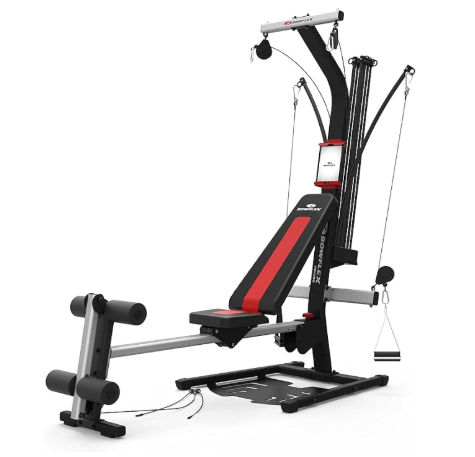
The Bowflex uses flexible polymer resistance rods instead of weight stacks or cable pulleys, which means no moving metal parts and no dropping plates. It covers over 60 exercises across chest, back, arms, shoulders, and legs from a single unit.
Key features:
- Polymer “power rod” resistance system delivers constant tension through the entire range of motion, unlike free weights that lose tension at the top
- Foldable design allows storage against a wall when not in use
- Adjustable resistance from roughly 5 lbs up to 210 lbs depending on the model
- Works for both beginners and intermediate lifters without requiring a spotter
The Bowflex burst onto the scene in the early 1990s, replacing traditional weights and pulleys with a system of polymer rods that delivered constant resistance throughout each movement. That constant tension is the defining feature – free weights lose resistance at the top of most movements, but the Bowflex rods continue pulling back through the full range of motion.
The frame design is largely the same across 30 years of production. The bench is central, cables run from the rod tower above, and foot attachments extend the lower-body exercise options. Setting up a new exercise takes 30–60 seconds of cable re-routing – less convenient than a cable machine at a commercial gym, but acceptable for home use.
The company behind Bowflex eventually purchased Nautilus Inc., Schwinn Fitness, and StairMaster Fitness, which tells you something about the commercial success the brand achieved through the 90s and 2000s. That said, Bowflex filed for bankruptcy in March 2024 before being acquired by Johnson Health Tech – so buying new units today means dealing with new ownership; used units from the 90s and 2000s remain structurally sound.
The main limitation is upper-body bias. The Bowflex covers pressing, rowing, and curl movements well. Squatting and leg pressing are possible but feel awkward compared to a proper rack. Treat it as a strength tool for upper body and supplementary for lower body.
Pros:
- Constant tension through full range of motion – more time under tension per rep than free weights at the same load
- Over 60 exercises from a single unit; no need to buy separate cables, bars, or attachments
- No dropped weights, no spotters needed – genuinely safer for solo home training
- Folds against the wall when not in use
Cons:
- Lower-body exercises (squats, leg press) feel mechanical and limited compared to free weights
- Resistance rods can crack or lose tension over time on older models – inspect before buying used
- Bulkier than it looks in photos; measure your space before purchase
Best for: Solo home trainers who want a full upper-body strength program without free weights or spotters
Not Ideal For: Anyone prioritizing heavy compound lower-body work (barbell squat, deadlift) – a rack and plates will serve that goal better
Where to find it in 2026: Remanufactured Bowflex units are available through Fitness Superstore starting around $200–$500; used models appear on eBay regularly
2. StairMaster 4000PT – Best 90s Cardio Machine for Real Results
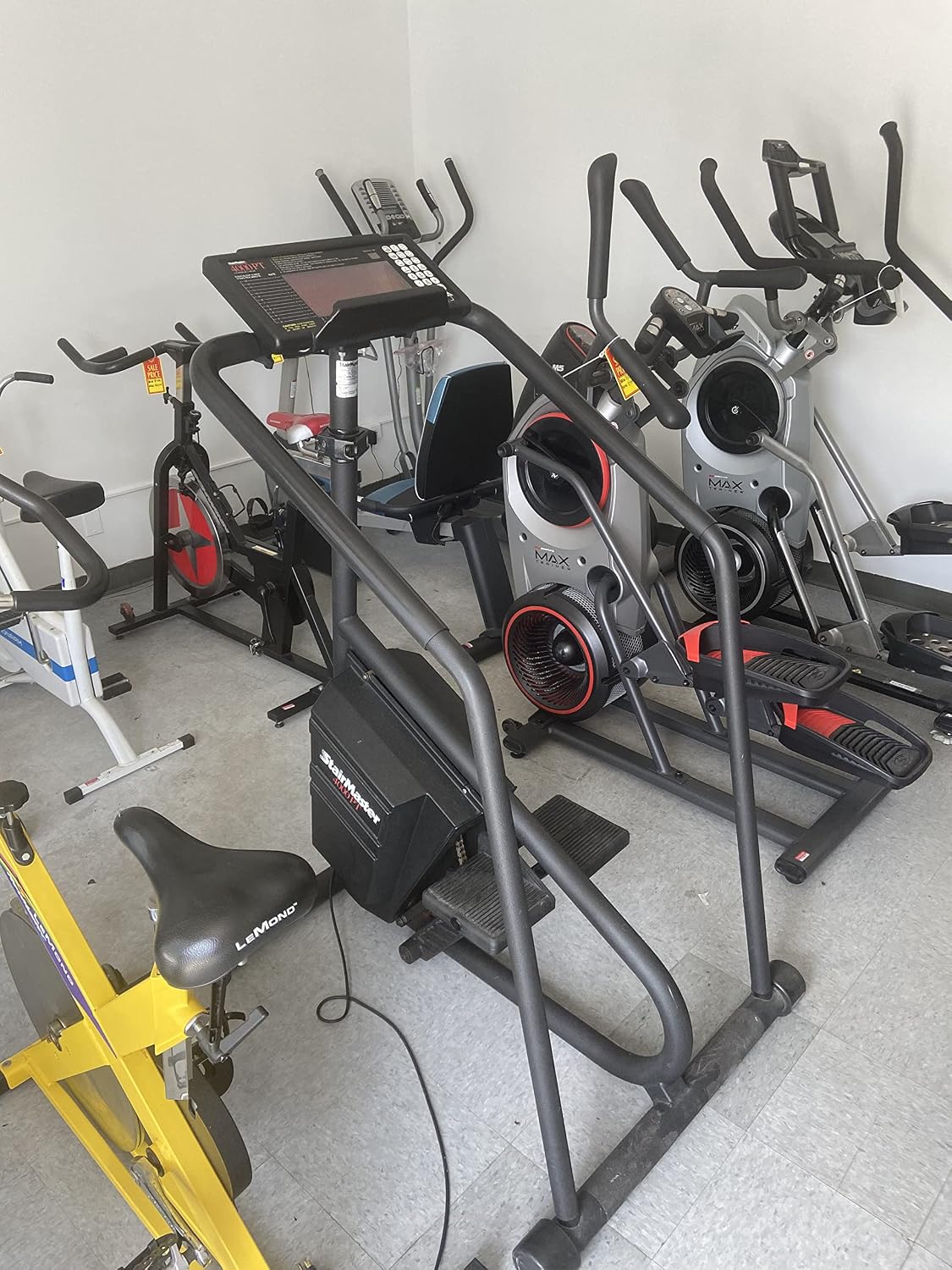
The StairMaster 4000PT is a self-powered step machine that simulates continuous stair climbing. StairMaster began in 1983 and became an enormous success, and the 4000PT model defined what 90s gym floors looked like. Unlike the consumer-grade steppers sold in infomercials, this was commercial hardware built for daily use.
Key features:
- Independent revolving pedals (not linked), which forces each leg to work separately
- Self-powered – no motor, meaning the resistance is entirely user-generated
- Targets glutes, quads, calves, and core simultaneously during each step cycle
- Commercial steel frame rated for heavy daily use; many machines from the early 90s are still operational today
The StairMaster 4000PT’s defining feature is its independent revolving pedals. Unlike linked steppers where one foot going down forces the other up, each pedal on the 4000PT moves independently. That means each leg must generate its own upward force, which produces higher glute and quad activation per step.
The machine is self-powered – there is no motor. Your legs move the pedals; the machine adds resistance through a built-in brake mechanism. Commercial units from the early 90s were built to withstand eight-hour daily use at a health club. Many of those machines are still in service 30 years later, which is a meaningful data point about build quality.
The cardiovascular output from a StairMaster session at moderate intensity is comparable to running at a 6-minute-mile pace, without the impact loading. That combination – high calorie burn, low joint stress – is why physical therapists often recommend stair climbers for clients returning from knee surgeries.
Pros:
- Independent pedals force full unilateral leg effort on each step – no coasting
- Self-powered design means no motor to fail and no electricity cost
- Commercial-grade steel; original units are still operational after 30+ years
- High calorie burn relative to perceived effort, especially for heavier users
Cons:
- Large footprint – original 4000PT units are not designed for small rooms
- No folding or compact storage option
- Difficult to find original units in reliable working condition; refurbishment is often needed
Best for: Anyone wanting the highest cardiovascular output-per-minute from a 90s machine
Not Ideal For: Small apartments or anyone without access to a garage, basement, or dedicated room
Where to find it in 2026: Commercial fitness resellers and eBay frequently list refurbished 4000PT units; Nautilus acquired the StairMaster brand and still sells a successor line
3. NordicTrack Cross-Country Ski Machine – Best Low-Impact Full-Body Cardio
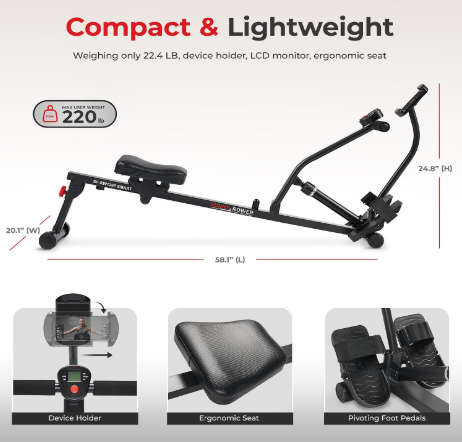
The NordicTrack Cross-Country Ski Machine replicates the motion of Nordic skiing: both arms and legs move in opposition, producing a simultaneous upper and lower body cardio workout. NordicTrack launched a fitness-center-specific model in 1990, and its 900-T version in 1993 added built-in handrails to make the machine easier to use.
Key features:
- Engages arms, legs, and core in one continuous movement – burns more calories per minute than a treadmill at the same perceived effort
- Zero-impact: feet never leave the sliding track, which protects knees and ankles
- Adjustable resistance on both the leg track and the arm poles independently
- Folds to roughly the size of a large suitcase for storage
The NordicTrack’s motion is genuinely different from any other cardio machine in this guide. Both arms and legs work in opposition simultaneously – right arm with left leg, left arm with right leg – which is the same movement pattern as actual cross-country skiing. That total-body coordination produces a cardiovascular load that rivals rowing, with far less lower-back strain.
NordicTrack was founded in 1975, and by the early 90s had become the fitness machine to have at home; by 1995, however, the company began losing money and eventually closed all 300 of its retail stores in 1998, though it continues producing treadmills and exercise bikes under current ownership. That business collapse had nothing to do with the machine’s effectiveness it was a function of the 90s home-gym bubble bursting across the category.
The single biggest barrier is the learning curve. Most first-time users cannot coordinate the arm-leg opposition pattern immediately and step off after 2 minutes of frustration. Spending 3–4 short sessions learning the motion before judging the machine is worth it. Once the pattern clicks, it is genuinely one of the most efficient cardio tools ever made.
Pros:
- Full-body cardio in one machine – arms, legs, and core all engaged simultaneously
- Zero impact – no foot strike, no joint loading, safe for knee and hip injuries
- Folds compact for storage; lighter than most 90s machines
- Low-speed operation is just as valid as high-speed – effective across fitness levels once learned
Cons:
- High learning curve; most users quit before the motion becomes natural
- Arm pole resistance and leg track resistance are adjusted separately – setup takes practice
- Vintage units need lubrication and belt inspection before use; parts can be difficult to source
Best for: Experienced exercisers with joint issues who want maximum calorie burn without impact
Not Ideal For: Beginners who have not used a ski machine before and do not want to invest learning time
Where to find it in 2026: NordicTrack still sells a successor ski machine (the NordicTrack Classic Pro Skier); vintage 90s units show up on Facebook Marketplace regularly, often priced between $30–$150
4. Total Gym – Best 90s Machine for Bodyweight Resistance Training
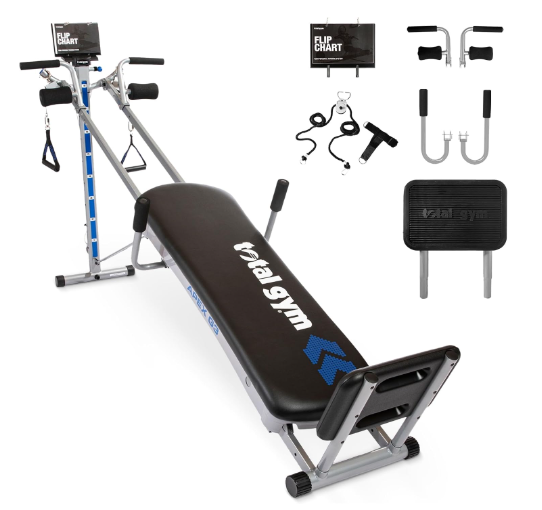
The Total Gym is an inclined sliding board with cables and pulleys that uses your own bodyweight as resistance.It allowed users to perform over 60 exercises targeting various muscle groups, folded for easy storage, and could be adjusted for bulk, tone, or flexibility goals depending on how the incline was set. Chuck Norris became its infomercial face in the 90s, and Christie Brinkley co-starred in the ads – which is part of why it became a cultural touchstone, not just a piece of equipment.
Key features:
- Bodyweight-based resistance scales automatically: steeper incline equals higher resistance, no weight selection needed
- The glideboard design allows pulling, pushing, and rowing movements from the same unit
- Works for users across a wide fitness range – beginners use low inclines, advanced users steep ones
- Compact fold-flat design stores under a bed
The Total Gym works differently from every other machine in this guide. You are the weight. The inclined board you lie or sit on pulls your bodyweight down the rail, and your muscles work against that load with each pulling or pushing movement. Raise the incline and you increase resistance without touching any adjustment knob.
The glideboard allows pulling or pushing against cables attached to handles while sliding along rails – a design that was genuinely unique among 90s home gym machines. That combination of bodyweight resistance and smooth sliding motion makes transitions between exercises fast; you adjust the incline, swap the attachment, and move on without rest.
The Total Gym is still in production, which means replacement parts and attachments are available – a significant advantage over discontinued machines like the Soloflex. Current models (the G3 Apex line) are structurally identical to the 90s versions in their core design, which validates the original engineering.
Pros:
- Bodyweight-based resistance automatically scales to the user – no plates to load, no stacks to pin
- 60+ exercises across upper body, lower body, and core from one machine
- Folds flat for under-bed storage; genuinely space-efficient
- Still in production – parts and attachments are available new
Cons:
- Upper-body resistance is limited by your own bodyweight; strong users hit a ceiling quickly
- Not a replacement for free-weight training if building serious mass is the goal
- The glideboard upholstery on vintage units often needs replacing – a minor but real maintenance task
Best for: Home users who prefer bodyweight-style training and want variety without stacking plates
Not Ideal For: Anyone with strength goals that require progressive overloading beyond their bodyweight
Where to find it in 2026: Total Gym is still in production; the current G3 Apex model retails for around $370 new, and vintage 90s units are widely available used
5. ThighMaster – Best for Inner Thigh Isolation (and Maximum Nostalgia Points)
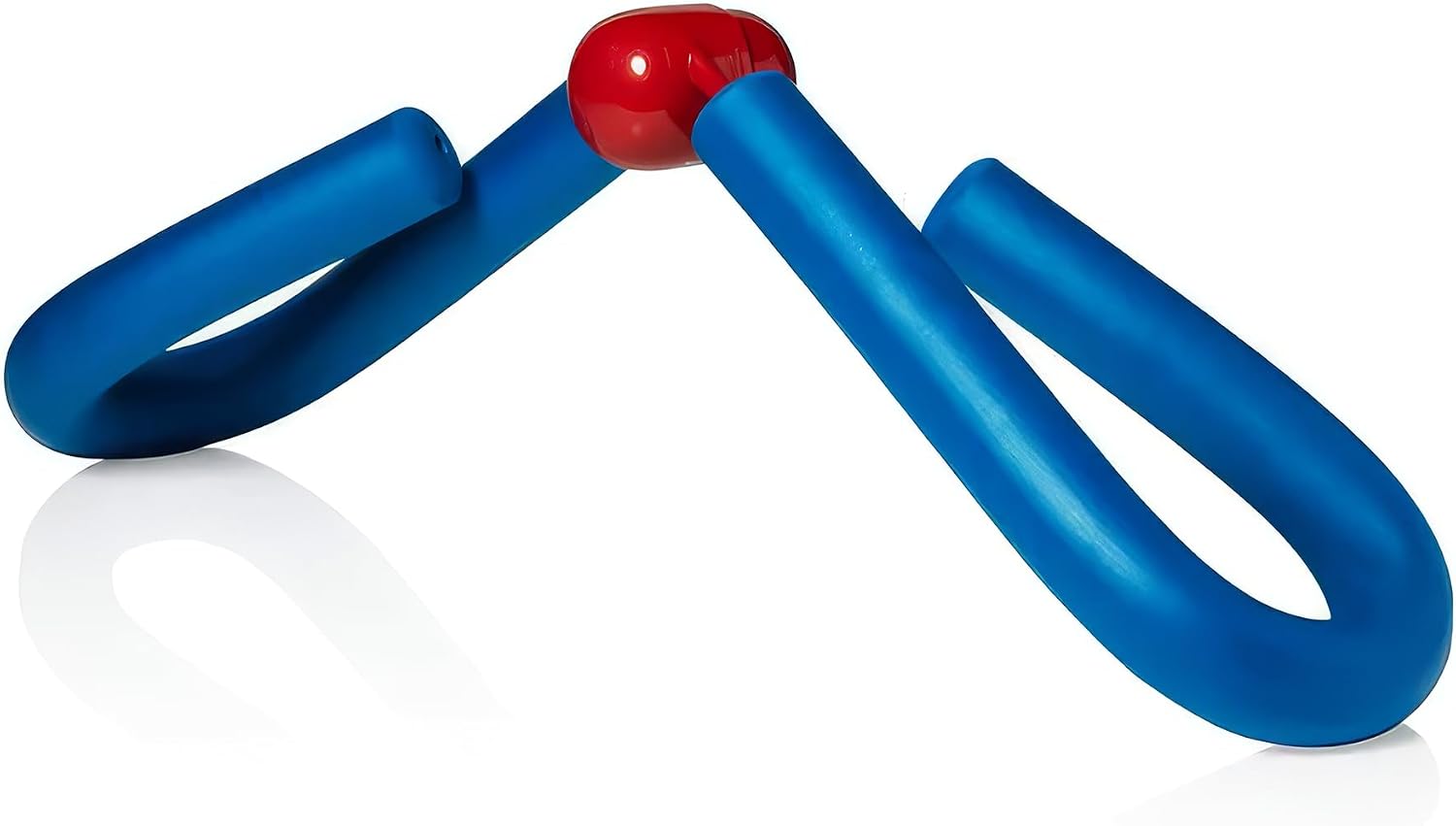
The ThighMaster is a spring-loaded V-shaped resistance device that you squeeze between your thighs to work the hip adductors. It targets one of the most undertrained muscle groups in the lower body – the inner thigh – and it works, within that narrow scope. Suzanne Somers said sales passed 10 million units, and she stopped counting at that point; she estimated total revenue from the product at close to $300 million.
Key features:
- Spring-loaded resistance targets hip adductors directly – a muscle group that most lower-body exercises miss
- Portable: weighs under 2 lbs and fits in a gym bag or desk drawer
- Can also be used for forearm and upper arm squeezing exercises
- No assembly, no setup, no moving parts to break
The ThighMaster is honest about what it does: it works your inner thighs, and that is it. The spring-loaded V-shape creates resistance as you squeeze your legs together, targeting the hip adductors – a muscle group that squats, lunges, and leg presses largely skip. That is a genuine training gap the ThighMaster fills.
Suzanne Somers started selling the ThighMaster in 1990 and reported that over 10 million units had sold, with total revenue approaching $300 million. The product is still sold new today for $19.95, which tells you it found a durable market. The appeal is partly the exercise benefit and largely the portability – it weighs under 2 lbs and travels in a carry-on bag.
The ThighMaster’s real limitation is range: it does one thing. Used as a standalone workout tool, it produces very limited overall conditioning. Used as a supplementary piece alongside a broader training routine – particularly for runners or cyclists who get little adductor work from their sport – it earns its place.
Pros:
- Targets hip adductors directly – the one muscle group most lower-body exercises miss
- Weighs under 2 lbs; fits in any bag
- Works immediately – no learning curve, no setup, no assembly
- Still sold new; spare units are cheap and easy to replace
Cons:
- Works only one small muscle group – not a substitute for any broader training
- Resistance is fixed; there is no way to increase difficulty as you get stronger
- The infomercial promise (spot-reducing thigh fat) was not scientifically accurate – the adductor-strengthening benefit is real, the “slimming” claim was not
Best for: Runners, cyclists, or anyone adding targeted inner-thigh work to an existing training program
Not Ideal For: Anyone looking for a machine that replaces or anchors a full workout routine
Where to find it in 2026: Still sold new at Suzanne Somers’ website for $19.95; vintage originals sell on eBay for $15–$40
6. Gazelle Glider – Best Low-Impact Cardio for Joint-Sensitive Users
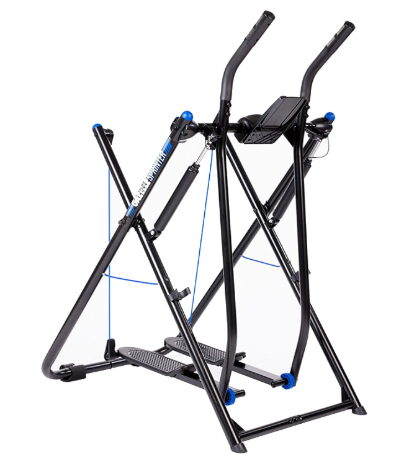
The Gazelle Glider is a stand-up elliptical-style machine where the user holds handlebars and swings legs in an arc while the platform moves freely. Fitness personality Tony Little promoted it in one of the most memorable infomercial campaigns of the late 90s. The motion is similar to a modern elliptical trainer but without the fixed track, which lets the stride length vary naturally.
Key features:
- Free-form foot path adapts to the user’s natural stride rather than forcing a fixed elliptical arc
- Simultaneously engages arms and legs for combined cardio output
- No motor or power supply – entirely user-powered
- Lightweight and folds flat; light enough to move between rooms
The Gazelle Glider’s free-form motion is its main advantage over the modern elliptical. A standard elliptical forces your feet to follow a fixed oval track. The Gazelle’s platform swings freely, so your natural stride length determines the motion path. Taller users take longer strides automatically; shorter users take shorter ones. That self-adjusting path is easier on hip flexors and knee joints than a fixed elliptical track.
Tony Little’s infomercials were intense – possibly too intense, given his energy level on screen – but the machine he was selling was genuinely solid entry-level cardio equipment. It has no motor, no weight capacity that creates safety risk, and no complexity that would stop a first-timer from using it correctly on day one.
The Gazelle is still in production as the Gazelle Edge, which is functionally identical to the 90s original. Buying vintage versus current makes almost no practical difference on this machine.
Pros:
- Free-form stride adapts to any user’s natural movement pattern – no fixed track to fight against
- No motor or electronics – nothing to fail or require servicing
- Works for combined arm-and-leg cardio or legs-only, depending on how you hold the handles
- Light enough to move between rooms; folds for storage
Cons:
- Resistance is low and fixed – more advanced users will outgrow it quickly
- Not a serious cardio machine for athletes; best suited for moderate activity levels
- The plastic frame on vintage units can develop creaks over time
Best for: Beginners, older adults, or anyone recovering from injury who wants a gentle introduction to daily cardio
Not Ideal For: Athletes or anyone looking to push cardiovascular output above moderate intensity
Where to find it in 2026: The Gazelle Glider is still manufactured; the current Edge model retails for around $100 new; used 90s units appear on Craigslist and Facebook Marketplace for $20–$60
7. Soloflex – Best 90s Machine for Muscle-Building Focus
The Soloflex predates the Bowflex and uses a different approach: rubber strap “weight rings” attach to a steel bar frame to provide resistance for conventional barbell movements like bench press, squat, and bent-over row. Soloflex became a highly recognized home gym brand in the early 90s through its VHS-era infomercials, which featured extremely lean male models and the tagline “a machine like a gym.” The body composition of those ads sold a lot of rubber bands.
Key features:
- Bar-and-strap system mimics free-bar movements more closely than cable or rod systems
- Resistance is added by stacking rubber weight rings – simple, with no cable setup required
- All major compound movements are possible: squat, press, deadlift row, curl
- Heavy steel frame with a small footprint relative to its exercise range
The Soloflex is different from the Bowflex in one important way: its rubber weight rings stack onto a bar that moves like a barbell, not a cable. The bar path on a bench press, for example, follows the same arc as a free barbell – which means the proprioceptive and stabilizer-muscle demands are similar to real barbell training. The Bowflex’s cable system does not replicate that.
The rubber rings are the machine’s weakest link. Over 30 years, the rubber degrades, loses elasticity, and can crack. Buying a vintage Soloflex means inspecting the rings carefully and accepting that replacements may be needed. Original replacement rings are no longer manufactured; third-party alternatives exist but vary in quality.
Soloflex became a widely recognized home gym name through its early-90s infomercials and positioned itself as a premium alternative to weights – the price point at launch was $700–$900, which was serious money in 1992. The steel frame has held up on units that were maintained; the rubber has not.
Pros:
- Bar movement pattern more closely mimics free-bar exercises than cable systems
- Heavy steel frame is built to last – structural failures on well-maintained units are rare
- Covers all major compound movements: press, row, squat, curl
Cons:
- Rubber weight rings degrade over time; vintage units often need ring replacement
- Replacement rings are no longer manufactured by Soloflex – third-party options only
- Company is no longer in operation; no manufacturer support for repairs
Best for: Someone who wants the feel of barbell training without the cost or space of a full rack and weight set
Not Ideal For: Anyone unwilling to do upfront maintenance on a used machine before starting to train with it
Where to find it in 2026: Soloflex no longer manufactures equipment; vintage units appear on eBay and local marketplace listings, typically priced $50–$200 depending on condition and included attachments
8. Ab Roller / Ab Wheel – Best 90s Equipment That Still Gets Used in Modern Gyms
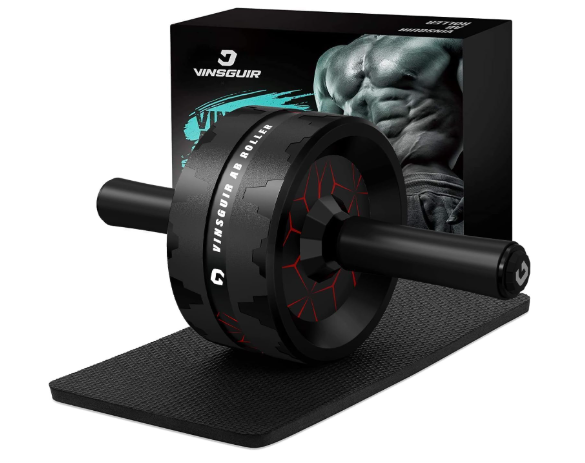
The Ab Roller (also sold as the Ab Wheel) is a small wheel with a handle on each side that you kneel behind and roll forward, extending your body into a plank-like position. It targets the rectus abdominis, obliques, and hip flexors in a way that crunches do not replicate. Unlike most 90s fitness gadgets, exercise scientists still endorse it. Its original design was promoted as supporting the neck during crunches, though its true value is the rolling-out movement itself, not the crunch assist.
Key features:
- The rollout motion creates eccentric loading on the abs – a stimulus that standard crunches do not produce
- Compact: fits in a drawer, weighs under 1 lb
- Works for intermediate to advanced users; beginners often find the full rollout too difficult initially
- Modern versions are identical to 90s versions in design and function – the original got it right
The Ab Roller costs $15 new, takes up no floor space, and produces results that more expensive equipment does not match for core training. The rollout movement creates a long-lever anti-extension load on the abs – meaning your core resists the force trying to collapse your lower back as you roll forward. That is a fundamentally different and more demanding stimulus than a crunch.
The machine has not changed since the 90s because there was nothing to improve. Modern versions are identical to vintage ones in design and function. Buying a 90s original is purely a nostalgia choice; the $15 version from any sports retailer works identically.
The limitation is skill level. Beginners often lack the core strength to perform a full rollout without their lower back collapsing under the load. Starting from a kneeling position, rolling only halfway out, and building distance over weeks is the correct progression. Jumping to a full standing rollout immediately is how people injure their lower backs.
Pros:
- Creates genuine eccentric abdominal loading that crunches, planks, and sit-ups cannot replicate
- Weighs under 1 lb; stores anywhere
- Works indefinitely – no parts to replace, no maintenance required
- Endorsed by current exercise science; not a gimmick
Cons:
- Requires existing core strength to perform correctly – beginners need a progression plan
- Does not address cardio, upper body, or lower body; a core-only tool
- Full standing rollout is an advanced move; most users need months to work up to it
Best for: Anyone with baseline core strength who wants a single compact tool for serious abdominal development
Not Ideal For: Complete beginners who have no existing core training baseline
Where to find it in 2026: Available new at any sporting goods store for $10–$30; the design has not changed since the 90s
Comparison Table: 90s Exercise Equipment at a Glance
| Machine | Best For | Still in Production? | Real Training Value | Typical Used Price |
|---|---|---|---|---|
| Bowflex Home Gym | Full-body strength at home | Yes (under new ownership) | High | $200–$500 |
| StairMaster 4000PT | Cardiovascular conditioning | Successor models available | Very High | $300–$800 refurbed |
| NordicTrack Ski Machine | Low-impact full-body cardio | Yes (current Pro Skier model) | High (once learned) | $30–$150 |
| Total Gym | Bodyweight resistance training | Yes (G3 Apex line) | Medium-High | $60–$200 |
| ThighMaster | Inner thigh isolation | Yes (still sold at $19.95) | Narrow but real | $15–$40 |
| Gazelle Glider | Beginner / joint-sensitive cardio | Yes (Gazelle Edge) | Medium | $20–$60 |
| Soloflex | Bar-movement strength training | No (discontinued) | High if maintained | $50–$200 |
| Ab Roller / Ab Wheel | Core strength | Yes (identical design) | High | $10–$30 |
Common Mistakes When Buying 90s Exercise Equipment
- Skipping a mechanical inspection on used machines. Resistance rods crack, rubber bands degrade, and cable pulleys seize up. Test every moving part before committing to a purchase or ask the seller for a video of the machine in motion.
- Buying based on infomercial claims rather than exercise science. The ThighMaster will not spot-reduce your thigh fat. The NordicTrack will not turn you into a competitive skier. Understand what each machine actually loads anatomically before setting expectations.
- Underestimating space requirements. A Bowflex or StairMaster needs significantly more clearance than the listed footprint suggests – account for the full range of motion, not just where the machine sits.
- Ignoring the learning curve on complex machines. The NordicTrack Ski Machine in particular requires 3–5 sessions before the arm-leg coordination pattern becomes natural. Giving up after one frustrating session is the most common reason these machines end up back on Craigslist after two weeks.
Frequently Asked Questions About 90s Exercise Equipment
What is the best 90s exercise machine for a full-body workout?
The Bowflex Home Gym covers the most exercises from a single unit – over 60 movements across all major muscle groups. The Total Gym is the closest alternative, using bodyweight resistance instead of polymer rods. Both machines handle upper body well; neither fully replaces free-weight squatting and deadlifting for lower body.
Are 90s exercise machines still worth buying in 2026?
Several are, yes. The Bowflex, StairMaster, Total Gym, and Ab Roller all deliver training results that match their modern equivalents – sometimes surpass them at the same price point when bought used. The gimmick machines (ab vibrators, sauna suits, toning shoes) do not deliver results and never did. Separate the category by exercise science validity, not by decade.
What is the difference between the Bowflex and the Soloflex?
The Bowflex uses polymer resistance rods attached to cables, which produces a cable-machine-style pulling and pushing motion. The Soloflex uses rubber weight rings on a bar that moves in an arc similar to a barbell. The Soloflex more closely mimics free-bar movements and engages more stabilizer muscles; the Bowflex covers more exercise variety from a single setup. Neither is definitively better – they solve different problems.
How do I find 90s exercise equipment in good condition?
Facebook Marketplace and Craigslist are the most reliable sources for local pickup, which lets you inspect the machine in person before buying. eBay has more selection but shipping large machines is expensive. Specialty fitness resellers like Fitness Superstore carry remanufactured commercial units (especially StairMasters and Bowflex) with warranty coverage – worth paying a premium for if condition matters.
Which 90s exercise machine has held up best over time?
The StairMaster 4000PT. Commercial-grade steel construction means original machines from the early 1990s are still fully operational in gyms today – over 30 years of continuous use. The Bowflex comes second: the frame is durable, though resistance rods need inspection. Avoid vintage machines with rubber components (Soloflex weight rings) without inspecting them first.
What 90s exercise equipment is purely a nostalgia buy with limited workout value?
The ab-belt (electrical muscle stimulator), the sauna suit, and any vibrating platform sold for “passive weight loss.” The ThighMaster and Gazelle have real (if narrow) functional value; the above three do not deliver measurable fitness outcomes.
Final Verdict
For actual training results in 2026, the Bowflex Home Gym is the pick: it is still commercially available, covers the most exercises per square foot of floor space, and the resistance-rod system remains scientifically valid. For pure cardiovascular conditioning, nothing from the 90s beats a well-maintained StairMaster 4000PT – and refurbished commercial units are available.
If you are building a 90s-themed home gym for nostalgia and functional training combined, pair a Total Gym with an Ab Roller and a NordicTrack Ski Machine: all three still hold up, all three take limited space, and all three produce real results once you learn to use them correctly.