8 Best Compact Exercise Equipment for Small Spaces in 2026
[Published: September 6, 2022 | Last updated: September 1, 2026] | 12 min read
The best compact exercise equipment fits your apartment, delivers real results, and stores out of the way when you’re done. This guide covers 8 tested picks across every category.
TL;DR
- Best overall: TRX GO Suspension Trainer – weighs 1.56 lbs and replaces a full gym’s worth of equipment in a door frame.
- Best adjustable dumbbells: REP Fitness QuickDraw – up to 60 lbs per hand, lifetime warranty, drop-rated design, replaces a 12-pair rack.
- Best budget cardio: Sunny Health & Fitness Mini Stepper – under $90, 300-lb capacity, includes resistance bands, fits under any desk.
- Best for working from home: Cubii JR1 Under-Desk Elliptical – pedal silently through meetings, rated top pick by Consumer Reports (2026).
- The global home fitness equipment market reached $12.88 billion in 2025 and is on track for $22.99 billion by 2034 (Fortune Business Insights, 2025) – compact equipment is the fastest-growing segment.
What to Look for in Compact Exercise Equipment
Before the product reviews, here are the criteria used to evaluate every item in this guide:
| Criterion | Why It Matters |
|---|---|
| Floor footprint (sq ft) | Equipment that takes over your living room stops being used within weeks |
| Storage method | Foldable, vertical-standing, or under-bed storage determines daily usability |
| Exercise variety | Multi-function gear gives you more results per square foot |
| Weight capacity | Underdisclosed limits lead to safety problems and early wear |
| Noise level | Apartment living means your neighbors matter – look for hydraulic or magnetic resistance |
| Assembly time | Complex setup is a barrier to regular use; under 30 minutes is the target |
| Resistance adjustment | Fixed resistance limits your ability to progress as you get stronger |
| Warranty length | Compact machines have more mechanical parts that can wear – longer is better |
| Price-per-exercise-type | Divide cost by the number of distinct movement patterns you can perform |
| App connectivity | Optional but useful if you need guided programming to stay consistent |
In-Depth Reviews
These 8 picks cover every major training goal – cardio, strength, full-body, and rehabilitation – without requiring more than a few square feet of floor space. Each was evaluated against the criteria above using data from published 2025-2026 testing by certified fitness reviewers.
1. TRX GO Suspension Trainer – Best Overall Compact Home Gym
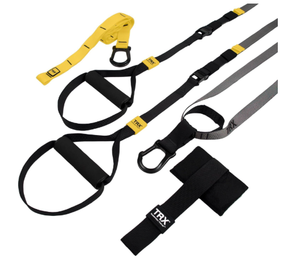
The TRX GO is a full-body training system that weighs 1.56 lbs, anchors to a door frame, and supports over 300 exercises from push-ups to rows to single-leg squats. For sheer exercise-per-square-inch value, nothing in this guide comes close.
Key features:
- Weight: 1.56 lbs total; ships in a carry pouch the size of a paperback book
- Supports up to 700 lbs; commercial-grade nylon straps with cam-lock buckle
- Over 300 exercises covering strength, stability, core, and mobility
Pricing: ~$130 (TRX website and Amazon)
TRX was created in 1997 by Navy SEAL Randy Hetrick, who built the first prototype from jiu-jitsu belt webbing. The GO is TRX’s travel-specific model, stripped to the essentials. When it hooks to a standard door frame, you have a complete resistance training setup in under two minutes (GarageGymBuilders, 2026).
The cam-lock adjustment mechanism is the main thing separating TRX from the $25-$40 knockoffs on Amazon. Tested through 5-7 sessions per week, the cam-lock shows no degradation in friction or buckle tension. Budget alternatives develop stiff buckles within 2-3 months of daily use (GarageGymBuilders, 2026). If you train twice a week, the cheaper versions work fine. Daily trainers will notice the difference within a few months.
Suspension training difficulty scales by adjusting your body angle, not swapping weights. This makes it useful for beginners doing assisted push-ups and for advanced athletes running single-arm rows and Bulgarian split squats from the same anchor. That range is rare in compact equipment.
The TRX Training Club app pairs with the GO for guided workouts, though it requires a paid subscription after a trial period. The equipment itself works without it.
Pros:
- Stores in a bag smaller than a laptop sleeve
- 700-lb tested load rating holds up to explosive movements
- Door anchor, wall anchor, and outdoor anchor all included
- Exercise difficulty adjusts in seconds by shifting foot position
Cons:
- Requires a stable door frame or ceiling mount – not every door works
- No external weight loading; difficulty is body-angle dependent
- Premium price vs. knockoffs that perform adequately for light use
Best for: Anyone with under 10 sq ft to spare who wants a single piece of equipment covering strength, mobility, and core work.
Not ideal for: Heavy lifters who need loaded squats and deadlifts exceeding bodyweight resistance.
2. REP Fitness QuickDraw Adjustable Dumbbells – Best Compact Strength Training
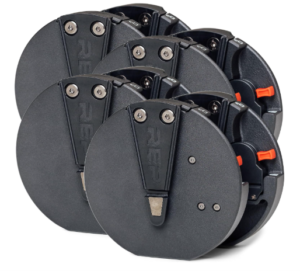
The REP QuickDraw replaces up to 12 pairs of dumbbells in the footprint of one pair, using a patented Lock-N-Load switch system for weight changes in under two seconds. It is the most durable adjustable dumbbell tested by Garage Gym Lab as of 2026 (Garage Gym Lab, 2026).
Key features:
- Weight range: 5-60 lbs per dumbbell, in 2.5 and 5 lb increments
- Steel handle with knurling – same texture as traditional fixed dumbbells
- Lifetime warranty; drop-tested at multiple angles including two-story height
Pricing: ~$449 per pair (REP Fitness website)
The biggest practical difference between the QuickDraw and dial-based alternatives is the handle. The steel, knurled grip feels like a real gym dumbbell – not a plastic shell with plates clipped inside. That matters during exercises like hammer curls, neutral-grip rows, and single-arm press variations where grip security directly affects form (Garage Gym Lab, 2026).
The Lock-N-Load pin switch is faster than any dial system. Pull the pin, slide the dumbbell out of the cradle, and you’re set. Weight changes take about the same time as picking up the next fixed dumbbell in a rack. Competing dial systems require placing the dumbbell back in the cradle, turning both dials, and then lifting again.
REP drop-tested the QuickDraws at various heights and angles before release. Most adjustable dumbbells carry explicit no-drop policies because the internal mechanisms crack under impact. The QuickDraw is one of the few that withstood being dropped from two stories (Garage Gym Lab, 2026). The lifetime warranty backs that claim.
The 60-lb ceiling covers the majority of home gym users. Advanced lifters doing heavy barbell work may find this limiting on exercises like Romanian deadlifts. For upper-body and accessory training, 60 lbs handles more than most people need.
Pros:
- Steel handle with knurling gives traditional dumbbell feel
- Weight change in under 2 seconds via Lock-N-Load pin
- Drop-rated and backed by a lifetime warranty
- 2.5 lb increments allow fine-tuned progression
Cons:
- 60-lb ceiling limits advanced compound lifters
- Higher price than dial-based alternatives
- Cradle takes up modest counter or floor space
Best for: Home gym users who want real-dumbbell feel, fine weight increments, and long-term durability without a full rack.
Not ideal for: Advanced powerlifters who routinely exceed 60 lbs per hand on primary lifts.
3. Sunny Health & Fitness Mini Stepper with Resistance Bands – Best Budget Cardio Pick
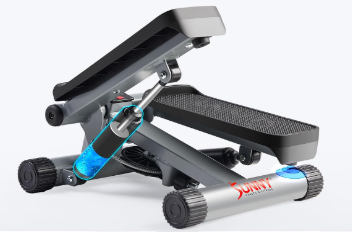
The Sunny Health & Fitness Mini Stepper is the most-reviewed compact cardio machine in its price category, with over 36,000 Amazon ratings and a price under $90. It burns calories via low-impact stepping while the included resistance bands add upper-body work.
Key features:
- Dimensions: approximately 17″ x 12″ x 13″; weighs 15 lbs
- 300-lb weight capacity; steel frame with hydraulic resistance system
- LCD monitor tracks steps, calories, and time; resistance bands included
Pricing: ~$88 (Amazon, with frequent coupons bringing it under $55)
The hydraulic resistance system is quiet enough for apartment use. Unlike motorized treadmills or spin bikes, there is no flywheel hum or belt noise. The stepping motion is self-powered – the only sound is faint hydraulic compression on each step, which Garage Gym Reviews (2026) describes as inaudible past a few feet.
The step height is shorter than a full stair climber. This is by design – compact steppers work best for 15-30 minute HIIT-style sessions rather than long steady-state cardio. A 30-minute moderate-intensity circuit burns 150-300 calories (FitBeast, 2025). Pairing stepping with the included resistance bands during that same session adds upper-body work without a second machine.
At 15 lbs, the stepper slides under a desk or bed in seconds with no disassembly. This is the defining practical advantage over full-size cardio machines, which require either a fold-down mechanism or dedicated floor space.
The 300-lb weight capacity is higher than most competitors in this price range. Comparable steppers typically cap at 220 lbs – a meaningful gap for larger users.
Pros:
- Under $90, often discounted under $55
- Quiet hydraulic system – apartment-safe
- 300-lb weight capacity, above category average
- Resistance bands included for full-body sessions
Cons:
- Short stride limits intensity for advanced athletes
- Basic LCD only – no Bluetooth or app on the classic model
- Not suited for continuous sessions over 45 minutes
Best for: Budget-focused buyers, apartment dwellers, beginners adding daily movement, and anyone needing a full-body option in under 2 sq ft.
Not ideal for: Experienced athletes looking to replace a stair climber or rower for sustained cardio output.
4. Cubii JR1 Under-Desk Elliptical – Best for Working from Home
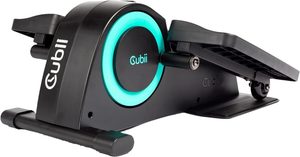
The Cubii JR1 is the top-rated under-desk elliptical by Consumer Reports (2026), Wirecutter, and multiple independent review outlets. It fits under any standard desk, operates at approximately 50 dB (quieter than normal conversation), and lets you pedal through work calls without disrupting anyone.
Key features:
- Dimensions: 23.5″ x 17.5″ x 10″ – fits under most desks with 9″ clearance
- 8 resistance levels; elliptical pedal motion (not circular like a mini bike)
- Weight: 25.4 lbs; Bluetooth to Cubii app for tracking
Pricing: ~$229 (Amazon)
The elliptical stride pattern is the key mechanical difference between the Cubii JR1 and cheaper pedal exercisers. A circular pedal motion creates a knee-up-knee-down action that can hit the underside of desks and disrupts typing rhythm. The JR1’s elliptical motion stays lower and flatter, keeping shins parallel to the floor – the same path as walking (Reviewed.com, 2026).
Consumer Reports tested this unit against competing models and ranked it top pick, citing smooth motion, quiet operation, and durable construction. The weighted flywheel carries momentum between strokes, producing fluid motion rather than the jerky resistance of lighter friction-based pedal units.
The 8-level resistance range spans from genuinely passive movement – useful for circulation during long meetings – to a light cardio challenge that raises heart rate. Most users report spending 2-4 hours daily on the JR1 during work sessions without affecting their output.
At 25.4 lbs, the JR1 is heavier than some competitors – a tradeoff that pays off in stability. Lighter units slide on hard floors during use and require grip pads. The JR1 stays put without any accessories.
Pros:
- Top-ranked by Consumer Reports (2026) in its category
- Elliptical stride fits under desks without knee clearance problems
- 50 dB noise level – safe for video calls
- Bluetooth app tracks daily movement and weekly goals
Cons:
- $229 is the higher end for a pedal exerciser
- 25.4 lbs makes carrying between rooms inconvenient
- No motorized assist – not suitable for passive rehabilitation pedaling
Best for: Remote workers, desk-bound professionals, and anyone targeting circulation and light daily activity while seated.
Not ideal for: Users needing motorized pedal assist for injury rehabilitation, or anyone wanting intense cardio output.
5. Fit Simplify Resistance Loop Bands Set – Best Budget Multi-Exercise Tool
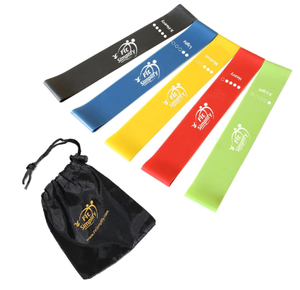
A set of five resistance loop bands covers strength, mobility, physical therapy, and High-Intensity Interval Training (HIIT) for around $12 – making it the lowest cost-per-exercise-type option in this guide by a wide margin.
Key features:
- 5 bands in graduated resistance from extra-light to extra-heavy
- Natural latex construction; each band measures 12″ in diameter loop
- Includes carrying bag, door anchor, and ankle straps
Pricing: ~$12 (Amazon)
Resistance loop bands create constant tension throughout the full range of motion. Unlike free weights – where tension drops at the top and bottom of many movements – bands stay loaded throughout the entire stroke. This increases muscle fiber recruitment during exercises like squats, glute bridges, and lateral band walks. Resistance band circuit training burns 200-450 calories per hour depending on intensity, body weight, and rest periods (Living.Fit, 2026).
The 5-band set serves users across all experience levels. The extra-light band works as a physical therapy tool or mobility aid. The extra-heavy band provides genuine resistance for hip thrusts, pull-apart rows, and resisted push-ups. A beginner and an experienced athlete both get a complete session from the same set.
At 12″ diameter, the entire set fits inside a toiletry bag. This is the only item in this guide that travels in a carry-on without adding measurable weight or luggage space.
Loop bands have clear limits. They are not a replacement for heavy barbell training. They work best as the primary tool for beginners and mobility-focused athletes, or as supplementary work added to a weight training session.
Pros:
- Under $15 for five resistance levels
- Stores smaller than a water bottle
- Works for physical therapy, strength training, and HIIT circuits
- Door anchor and ankle straps expand the exercise count
Cons:
- Not a substitute for heavy compound strength training
- Band can roll during lower-body exercises if not positioned carefully
- Advanced lifters will outgrow top resistance quickly
Best for: Beginners, travelers, physical therapy patients, and anyone adding mobility or warm-up work to an existing routine.
Not ideal for: Intermediate or advanced lifters who need progressive overload beyond 30-40 lbs of effective resistance.
6. Stamina InMotion E1000 Compact Strider – Best for Standing Desk Users
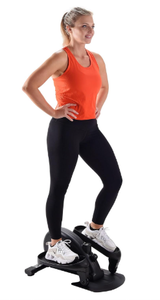
The Stamina InMotion E1000 is the only under-desk elliptical in this guide rated for standing use. Standing while pedaling burns more calories than seated pedaling – this is the pick for users who already use a standing desk or want the added movement of a standing workout.
Key features:
- Dimensions: 22.5″ x 16″ x 12″; weighs 26 lbs
- Rated for both seated and standing use (most competitors are seated-only)
- 5-level manual resistance; bilateral stride handles for standing balance support
Pricing: ~$130 (Amazon)
Most under-desk ellipticals are designed for sitting use only – the unit sits on the floor and you pedal while your chair supports your weight. The E1000 handles a user’s full body weight while standing, opening it to standing desk setups and active warm-up sessions (Consumer Reports, 2026).
The bilateral stride handles extend above the pedals and give balance support while standing. They fold down for seated configuration. This dual-mode design adds functionality without expanding the machine’s footprint.
Standing while pedaling activates leg muscles continuously, raising energy expenditure over seated use. For someone already using a standing desk 2-3 hours daily, adding the E1000 beneath it turns passive standing time into consistent light movement.
The E1000 is manual-resistance only, adjusted via a knob. There is no app, Bluetooth, or digital display. For users who want data tracking, this is a gap. For users who prefer a simple, durable machine with no tech dependencies, it is a practical advantage.
Pros:
- Only under-desk elliptical here rated for standing use
- Dual balance handles for standing stability
- Lower price than app-connected competitors
- Simple mechanics with no electronics to fail
Cons:
- No digital display or app connectivity
- Standing use requires a height-adjustable desk at the right position
- Less smooth pedal motion than the heavier Cubii JR1
Best for: Standing desk users who want to add movement to their existing setup, and buyers who prefer simple mechanics over connected features.
Not ideal for: Seated desk workers or anyone wanting workout data, app tracking, or more than 5 resistance levels.
7. NordicTrack X24 Foldable Exercise Bike – Best Compact Connected Cardio Machine
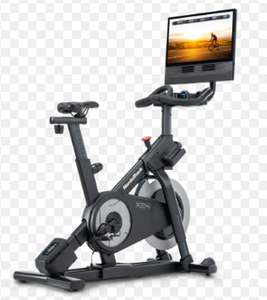
The NordicTrack X24 has an 8.54 sq ft floor footprint – one of the smallest among connected exercise bikes – with front transport wheels that let you reposition it solo (Garage Gym Reviews, 2026). It is the pick when you want coach-led workouts and performance tracking but cannot give up a full room to a treadmill.
Key features:
- Floor footprint: 8.54 sq ft (approximately 47″ L x 22″ W)
- Folds vertically to reduce footprint when not in use
- Includes iFit app integration with auto-adjusting resistance
Pricing: ~$999 (NordicTrack website)
The X24 sits between a traditional upright bike and a compact smart bike. The 8.54 sq ft active footprint compares to 12-15 sq ft for most full-size exercise bikes, while the fold-up storage reduces that further for rooms that double as living spaces (Garage Gym Reviews, 2026).
Magnetic resistance keeps the X24 quiet for apartment buildings. No belt or brake friction means the dominant noise is your breathing, not the machine. This matters significantly for shared walls.
The iFit integration is the standout feature. Trainer-led rides automatically adjust the bike’s resistance in real time during class – the bike responds to the coach’s commands without you turning any dial. For users who struggle with self-directed programming, this removes the workout planning burden entirely.
At ~$999, the X24 is the most expensive item in this guide. The price reflects connected features, a built-in screen, and NordicTrack’s build quality. For users who train daily and value guided workouts, the cost-per-session drops substantially over time.
Pros:
- 8.54 sq ft footprint is among the smallest for a full connected bike
- Transport wheels for easy repositioning
- iFit auto-adjusts resistance during trainer-led rides
- Quiet magnetic resistance – apartment-appropriate
Cons:
- ~$999 is the highest price in this guide
- iFit subscription required for full features at additional cost after trial
- Larger than all other items here – not a closet or desk storage option
Best for: Regular cyclists who want coach-led workouts, connected tracking, and a machine that fits in a bedroom or living room corner.
Not ideal for: Budget buyers, occasional exercisers, or anyone with under 10 sq ft of usable floor space.
8. TRX HOME2 Suspension Trainer System – Best Full Compact Home Gym System
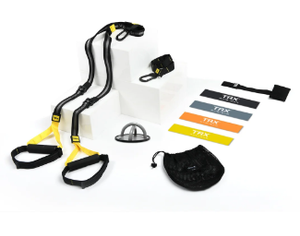
The TRX HOME2 is the complete version of the GO reviewed above. It adds a door anchor that works in both directions, longer straps for taller users, a mesh carrying bag, and 90-day access to TRX Training Club. If you want one system to replace a gym membership entirely, this is the pick (Furylist, 2026).
Key features:
- Full-length straps accommodate users from 4’8″ to 6’8″
- Includes door, floor, and wall anchor attachments
- 90-day TRX Training Club access with 300+ guided workouts
Pricing: ~$199 (TRX website)
The HOME2’s longer straps cover a height range the GO cannot. The GO works for most body heights but restricts full range on some lower-body movements for taller users. The HOME2 adds length to each strap and includes a carabiner for wall and ceiling attachment points.
A floor anchor is included in the HOME2 but not the GO. This expands the exercise library to ground-based movements like mountain climbers and pike presses with foot straps. For a user who wants a permanent training station, the wall anchor is the more practical long-term setup.
The TRX Training Club access is the real differentiator. The app organizes workouts by duration (15-60 minutes), difficulty level, and training goal. New sessions release regularly. If you need structured programming rather than self-direction, this removes that barrier from day one.
At $199 versus $130 for the GO, the premium buys extended strap length, a floor anchor, and the app trial. For most users at average height, the GO is sufficient. For taller users or anyone building a permanent wall-mounted station, the HOME2 justifies the $70 difference.
Pros:
- Accommodates users up to 6’8″ – the GO does not
- Wall, ceiling, and floor anchors included alongside door anchor
- TRX Training Club provides structured programming out of the box
- Same 700-lb load rating as the GO
Cons:
- $70 more than the GO for features average-height users may not need
- Still bodyweight-only resistance (no external loading option)
- App subscription required after the included trial period
Best for: Taller users, anyone setting up a permanent wall-mounted training station, and users who want app-guided programming from day one.
Not ideal for: Short-to-average height users who prioritize portability over a permanent setup – the GO handles those users at a lower price.
Comparison Table: 8 Best Compact Exercise Equipment at a Glance
| Product | Best For | Price | Active Footprint | Weight Capacity |
|---|---|---|---|---|
| TRX GO Suspension Trainer | Overall compact gym | ~$130 | 0 sq ft (door) | 700 lbs |
| REP QuickDraw Dumbbells | Compact strength training | ~$449/pair | <1 sq ft | 60 lbs/hand |
| Sunny Health Mini Stepper | Budget cardio | ~$88 | <2 sq ft | 300 lbs |
| Cubii JR1 Under-Desk Elliptical | Working from home | ~$229 | Under desk | 250 lbs |
| Fit Simplify Resistance Bands | Budget multi-purpose | ~$12 | 0 sq ft | ~35 lbs resistance |
| Stamina InMotion E1000 | Standing desk users | ~$130 | Under desk | 250 lbs |
| NordicTrack X24 Bike | Connected cardio | ~$999 | 8.54 sq ft | 300 lbs |
| TRX HOME2 System | Full home gym system | ~$199 | 0 sq ft (wall/door) | 700 lbs |
Common Mistakes to Avoid When Buying Compact Exercise Equipment
- Buying based on storage footprint alone: A machine that folds to 2 sq ft still needs 8-10 sq ft to use safely. Measure your actual workout space, not just the storage size.
- Ignoring weight capacity: Most compact machines list capacity between 220-300 lbs. Choose equipment rated at least 50 lbs above your body weight to account for dynamic load during movement.
- Skipping the noise check: Friction-based resistance is louder than magnetic or hydraulic. For apartment use, specify magnetic or hydraulic resistance in your search criteria.
- Overbuying connected features you won’t use: App-connected machines require subscriptions. If you won’t use coached workouts, pay for the simpler option and invest the difference elsewhere.
- Buying the maximum dumbbell weight available: Most people never exceed 30-40 lbs for 80% of exercises. A 60-lb ceiling covers the vast majority of home gym users (Garage Gym Lab, 2026).
Frequently Asked Questions About Compact Exercise Equipment
What is compact exercise equipment?
Compact exercise equipment is fitness gear designed to occupy minimal floor space during use and store out of sight between sessions. This includes suspension trainers that anchor to doors, adjustable dumbbells that replace full racks, under-desk ellipticals, mini steppers, and resistance bands. The defining characteristic is a small active footprint – typically under 10 sq ft – combined with easy storage.
How much space do I need for compact home exercise equipment?
Most compact machines need 6-10 sq ft of clear floor space to use safely, even if the folded storage footprint is smaller. Suspension trainers like the TRX GO require essentially zero floor space since they hang from a door or wall anchor. Under-desk ellipticals and mini steppers operate within a seated position, adding no extra space beyond your existing desk or chair footprint.
Is compact exercise equipment effective for real fitness results?
Yes. Suspension training, resistance bands, and adjustable dumbbells provide enough progressive resistance for meaningful strength development. Resistance band circuit training burns 200-450 calories per hour at moderate to high intensity (Living.Fit, 2026). The key variable is consistency, not equipment size. Home exercisers work out approximately 21% more frequently than gym-only members (CivicScience, 2026, via Home Gym Foundry).
What is the difference between compact and full-size home gym equipment?
The primary differences are resistance ceiling and exercise variety. Full-size equipment – power racks, barbells, cable machines – handles heavier loads and a wider movement library. Compact equipment typically tops out at bodyweight or 60 lbs of external resistance, making it best suited for general fitness, weight management, and upper-body strength rather than powerlifting or competitive bodybuilding.
Who should use compact exercise equipment?
Compact equipment works best for apartment residents with limited floor space, travelers who need portable options, beginners building a first home gym, and office workers adding movement to a sedentary workday. It is also the practical starting point for anyone testing whether home training fits their routine before investing in larger machines.
How do I choose the right compact exercise equipment for my goal?
Match the equipment type to your primary goal. For cardio: mini stepper, under-desk elliptical, or a compact exercise bike. For strength and muscle: adjustable dumbbells or a suspension trainer. For mobility and flexibility: resistance bands. For daily movement and circulation: an under-desk pedal exerciser. If budget allows only one purchase, a suspension trainer covers the widest range of goals in the smallest package.
Is compact exercise equipment suitable for beginners?
Yes – most compact options are easier to learn than free weights or barbell training. Suspension trainers adjust difficulty by shifting body angle, which beginners control intuitively with no rack setup or spotting required. Mini steppers have one variable (step speed) and no technical learning curve. Resistance bands require basic movement knowledge but carry no risk of dropping weight.
Final Verdict
The TRX GO ($130) is the best single purchase for most people – it weighs under 2 lbs, anchors to any door, and covers strength, core, and conditioning without taking up floor space. For users who want to add dedicated weight training, the REP Fitness QuickDraw dumbbells are the most durable and practical adjustable option at their price point. And for anyone tied to a desk most of the day, the Cubii JR1 delivers the best seated movement experience available in 2026.
The home fitness equipment market reached $12.88 billion in 2025 and is projected to hit $22.99 billion by 2034 (Fortune Business Insights, 2025). You do not need a dedicated gym room to train well – you need the right 2 square feet.